
Cotton Jassid Pest Information
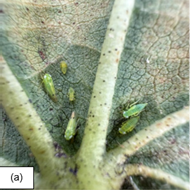
(a) Aggregations of cotton jassid
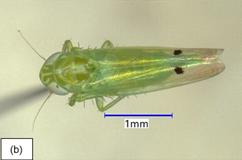
(b)Microscopic image of cotton jassid
Photos:
(a) Scott Graham, Auburn University
(b) Isaac Esquivel, University of Florida
Description
Adult cotton jassids measure approximately 1/8 of an inch (2-3 mm) in length and are pale green with yellowish-green wings. They can be distinguished from other leafhopper species by a prominent black spot on the apical area of each forewing and, often, by two dark spots on either side of the head. The markings sometimes can be faint or absent. Therefore, definitive morphological identification requires dissection and examination of the male genitalia by a specialist or confirmation through molecular testing.
The eggs, which are laid within the veins and midribs of leaves, are yellowish-white, oblong and less than 0.04 inch (1 mm) long, difficult to see without magnification.
Newly hatched nymphs are wingless, pale green and highly agile, often scuttling sideways or dropping from plants when disturbed; adult cotton jassids share this behavior. They are very small, typically less than 0.05 inch (1.3 mm) long—and difficult to distinguish from nymphs of other leafhopper species. Cotton jassid is reported to be more abundant on the underside of leaves.
History and Distribution
The cotton jassid is native to Asia, and its known distribution is primarily tropical or subtropical. Its native range extends from Iran to Japan. It is found in Niger, several Asian countries including India, Honduras, and some southeastern states in the United States. Its first Western Hemisphere report was in Puerto Rico in 2023. The cotton jassid is not known to be present in California; however, it is highly likely to establish a widespread distribution in California if it was introduced. In the late fall of 2024, cotton jassid was detected for the first time in the U.S. through Florida CAPS trapping network. In October 2025, a cotton jassid pest sample was intercepted on hibiscus from Alabama.
- Current Known North American Distribution (Map)
- Current Known North American Distribution (US State List)
Host Range
Cotton jassid is polyphagous and reported to feed on at least six plant families including Malvaceae, Fabaceae, Asteraceae, and Solanaceae. Crops targeted by the cotton jassid include cotton and okra, with potential for severe impacts on both. Grapes and tomatoes may be targeted as well.
Life Cycle
The number of generations per year for the cotton jassid varies depending on temperature and humidity. In India, generation times range from 15 to 46 days with up to eleven generations per year. Breeding occurs throughout the year, and populations are generally active throughout the year due to the continual availability of a wide range of alternative host species in warmer climates. Females oviposit eggs within the veins and midribs of host plants, making them difficult to see without specialized tools. Eggs hatch in about a week and are laid throughout the year by overlapping generations, with a female laying between 14 and 38 eggs in its lifetime. The nymphal stage lasts 5 to 16 days, and adults live for up to five weeks. Populations peak at multiple times during the year in regions where this pest occurs, but numbers tend to be highest during the hottest times of year between June and August.
Damage to Agriculture and Environment
Cotton jassid is a highly adaptable, polyphagous leafhopper that feeds on a wide range of crops and ornamentals, including at least six plant families such as cotton, grapevine, tomato, okra, eggplant, sunflower, and hibiscus - all commonly grown in California.
Cotton jassid feeding causes "hopperburn," which leads to brown leaf spots and curled edges eventually leading to defoliation. Loss of flowers, fruit, squares, and bolls have been reported. For cotton, damage can escalate within two weeks from mild discoloration to complete defoliation. Losses of cotton in Asia have been reported to reach 60%. Damage to okra has been reported to include chlorosis and burnt areas along leaf margins. Grapevines may develop chlorosis, leaf damage, and sooty mold.
Cotton jassid has not been confirmed to transmit pathogens. Six insecticides have been reported to show efficacy against the pest according to officials in Alabama.
The pest is regulated in countries such as Mexico and Iran. Detection in California could trigger quarantines, inspection burdens, or trade limitations.
Its broad host range, multivoltine lifestyle, and presence in warm-temperate regions of the southeastern U.S. indicate that many parts of California, including key agricultural regions, could support emerging populations.
Due to its wide host plant feeding range, cotton jassid could affect gardens, landscapes, and native vegetation through leaf damage and stress-induced decline.