
New World Screwworm Alert
June 11, 2026 – CDFA Announces New World Screwworm Entry Requirements for Animals Entering California
Effective June 12, 2026, at 9:00 a.m. Pacific Time, the California Department of Food and Agriculture (CDFA) is implementing additional New World Screwworm (NWS) entry requirements for animals entering California from NWS affected areas.
These requirements apply to livestock, poultry, camelids, equids, captive cervids, and companion animals, including dogs, cats, rabbits, pet psittacines, and domestic rodents.
Animals known or reasonably suspected to be infested with NWS may not enter California unless specifically authorized by CDFA.
Animals originating from an NWS-infested zone require:
- Premovement inspection within five (5) days prior to arrival in California
- Electronic Certificate of Veterinary Inspection (eCVI) with required NWS statement
- NWS Animal Movement Certificate, when required by the state of origin or federal animal health officials
- Appropriate NWS treatment, when applicable to the species
- California Entry Permit
Livestock and poultry originating from an NWS-surveillance zone require:
- Premovement inspection within seven (7) days prior to arrival in California
- Electronic Certificate of Veterinary Inspection (eCVI) with required NWS statement
- California Entry Permit
Dairy calves six (6) months of age or younger originating from an NWS-infested zone or NWS-surveillance zone require:
- Premovement inspection within five (5) days prior to arrival in California
- Electronic Certificate of Veterinary Inspection (eCVI) with required NWS statement
- Appropriate NWS treatment
- Navel treatment with an approved product for calves less than 3-weeks old
- California Entry Permit
Equids and companion animals originating from a state with an active NWS-infested zone require:
- Premovement inspection within seven (7) days prior to arrival in California
- Electronic Certificate of Veterinary Inspection (eCVI) with required NWS statement
- California Entry Permit
All animals entering California under these requirements must be inspected upon arrival at the California destination. Animals with signs consistent with NWS infestation, including larvae (maggots) in wounds or body openings, must be isolated immediately and reported to CDFA within 24 hours.
For full requirements, please review the Statewide Quarantine and Attachment NWS-1.
California Entry Permit Requests:
NWSpermitting@cdfa.ca.gov
evet@cdfa.ca.gov
909-247-8789
Report suspected NWS:
866-922-2473
cdfa.ahb_nws_info@cdfa.ca.gov
New World Screwworm Confirmed in Five Cases
SACRAMENTO, CA - June 8, 2026, the United States Department of Agriculture (USDA) Animal and Plant Health Inspection Service (APHIS) confirmed a total of four (4) cases of New World Screwworm (NWS), two calves in Zavala County, Texas, one calf in La Salle County, Texas, a goat in Gillespie County, Texas, and a dog in Lea County, New Mexico. USDA has activated the sterile fly dispersal facility at Moore Air Base in Edinburg, Texas and continues to release sterile flies infested and surrounding areas.
CA SITUATION STATUS
At this time, there are NO confirmed detections of New World Screwworm in California. CDFA is coordinating closely with USDA APHIS and neighboring state animal health officials to monitor the situation. All California dairies and livestock operations are encouraged to maintain vigilance. NWS is not a food safety concern. For national NWS detection data, visit the USDA APHIS website.
In addition to CDFA's fly trapping efforts to monitor NWS at California’s border, CDFA is updating animal importation requirements entering the state from known infected zones
REPORTING SUSPICIOUS CASES
California animal owners and veterinarians should monitor for draining or enlarging wounds, fly egg or maggot infestations, and lesions around body openings (ears, nose, genital area, umbilicus). All suspicious cases should be reported to CDFA immediately at 866-922-2473.
While not common in people, if you notice a suspicious lesion on your body or suspect you may have contracted screwworm, seek immediate medical attention.
INQUIRIES
For public inquiries regarding New World Screwworm in California, please send an e-mail to cdfa.ahb_nws_info@cdfa.ca.gov or call 866-922-2473.
For media inquiries, please call 916-654-0462 or send an e-mail to OfficeOfPublicAffairs@cdfa.ca.gov.
Follow us on Social Media: Facebook at Animal Health Branch-CDFA and on Instagram at animalhealthbranch_cdfa.
New World Screwworm Confirmed in Texas
SACRAMENTO, CA - June 4, 2026: June 4, 2026: The California Department of Food & Agriculture (CDFA) Animal Health Branch is issuing this notification in response to a confirmed detection of New World Screwworm (Cochliomyia hominivorax) in the United States.
On June 3, 2026, the United States Department of Agriculture (USDA) Animal and Plant Health Inspection Service (APHIS) confirmed the presence of New World Screwworm (NWS) in Zavala County, Texas. The affected animal is a 3-week-old calf and larvae were identified in its umbilical area. This is the first confirmed detection of NWS in animals in the continental United States since the parasite was eradicated from the U.S.
CA SITUATION STATUS
At this time, there are NO confirmed detections of New World Screwworm in California. CDFA is coordinating closely with USDA APHIS and neighboring state animal health officials to monitor the situation. All California dairies and livestock operations are encouraged to maintain vigilance. NWS is not a food safety concern.
For national NWS detection data, visit the USDA APHIS website.
BACKGROUND
New World Screwworm is a devastating parasitic fly whose larvae (maggots) infest the open wounds of warm-blooded animals, including livestock and wildlife, and in rare cases, humans. Unlike common blow flies, NWS larvae feed on living tissue, which can be fatal if untreated. NWS had been eradicated from the United States, Canada, and Mexico through a sustained sterile insect technique (SIT) program operated by USDA APHIS and partner agencies.
California has significant livestock and wildlife populations at risk. The re-introduction of NWS into the United States represents a serious threat to the agricultural economy and animal welfare.
REPORTING SUSPICIOUS CASES
California animal owners and veterinarians should monitor for draining or enlarging wounds, fly egg or maggot infestations, and lesions around body openings (ears, nose, genital area, umbilicus). All suspicious cases should be reported to CDFA immediately at 866-922-2473.
While not common in people, if you notice a suspicious lesion on your body or suspect you may have contracted screwworm, seek immediate medical attention.
INQUIRIES
For public inquiries regarding New World Screwworm in California, please send an e-mail to cdfa.ahb_nws_info@cdfa.ca.gov or call 866-922-2473.
For media inquiries, please call 916-654-0462 or send an e-mail to OfficeOfPublicAffairs@cdfa.ca.gov.
Follow us on Social Media: Facebook at Animal Health Branch-CDFA and on Instagram at animalhealthbranch_cdfa.
Screwworms are fly larvae (maggots) that feed on living flesh. These parasites can infect any warm-blooded animal. Screwworms enter wounds as small as a tick-bite and feed on living tissue in the area. If untreated, screwworm infestations can be fatal. In the US, Screwworm is a Foreign Animal Disease reportable within 24 hours of diagnosis. Screwworms have most recently entered the US in dogs that have been imported from areas of the world where the flies are endemic.
New World screwworm, Cochliomyia hominivorax, has been moving North again after years of being pushed down past the Darién Gap in Panama. While endemic in many regions of South America and some Caribbean Islands, the screwworm was recently found in Nuevo Leon, Mexico which is 70 miles off the US border.
While an adult screwworm fly is capable of flying for up to 10-14 days, they typically only fly short distances, 6-9 miles (10-15 km) when there are sufficient hosts in the area and suitable environmental conditions. Although the screwworm fly is capable of flying up to 125 miles, longer distance spread is more likely facilitated and propagated via transport on human and animal hosts.
Identification
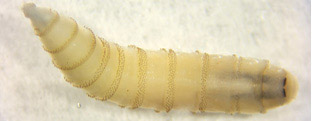
New World Screwworm Larvae
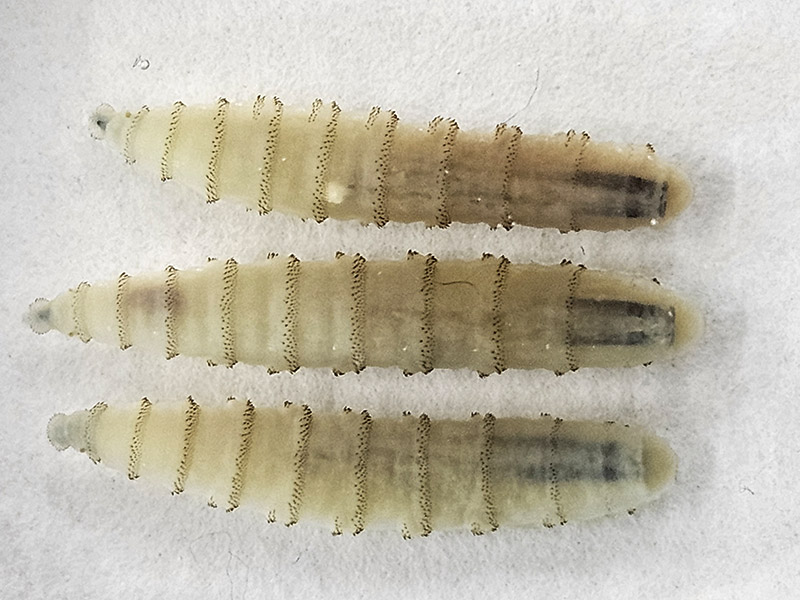
- Pale with encircling black spines
- No head capsule
- Long tapered appearance
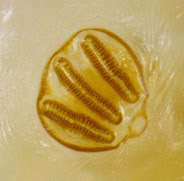
Immature Larvae
-
Larvae in myiasis cases may be recognized by the shape of their spiracles
- Number of slits = instar
- Sclerotized peritreme
- Button
- Positioning of tubercles
- Spines at segment margins
|
New World Screwworm
Cochliomyia hominivorax
|
Secondary Screwworm
Cochliomyia macellaria
|
|
|---|---|---|
| Distribution | Americas and Caribbean | Americas and Caribbean |
| Abundance | Low densities in the environment | Common/abundant in the environment |
| Climate | Warm-temperate to tropical | Temperate to tropical |
| Feeding habit | Living, warm-blooded animals | Carrion, rarely living animals |
| Importance |
Parasite of:
|
|
 |
 |
|
 |
 |
|
 |
 |
|
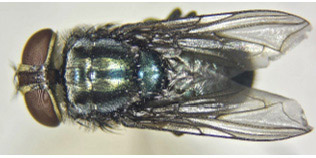
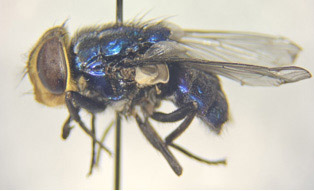
| Adult Screwworm Flies | 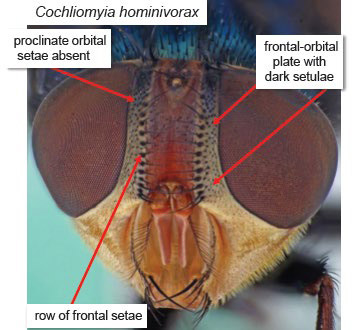 |
 |
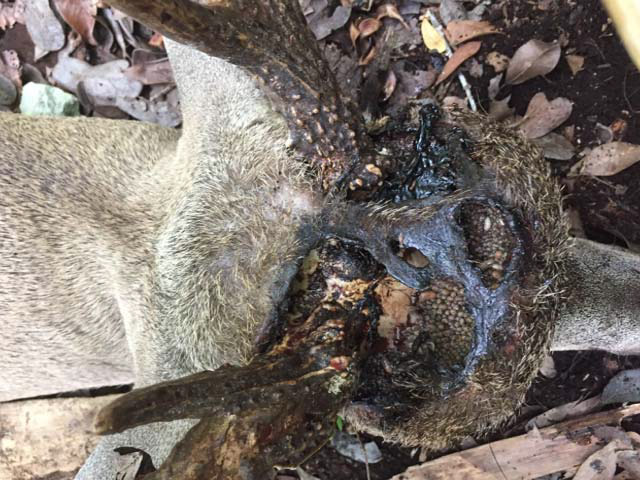
Infested animals may present with enlarging, draining, foul-smelling wounds and weight loss; they may isolate themselves and show signs of discomfort. Animals may die from secondary infection or toxicity in 7-14 days if not treated.
Wounds that might become infested include those caused by: Tick bites, castration or dehorning, branding, shearing, and sore mouth in sheep.
In addition, screwworms can infest the navels of newborn mammals, and mucous membranes of bodily orifices, including: nostrils and sinuses, eyes, mouth, ears, vulva, anus, prepuce, and urethral fossa.
Reporting
Screwworm infestation is a foreign animal disease and must be reported to CDFA or USDA animal health officials within 24 hours of diagnosis or suspicion for all livestock and pet.
Samples of eggs and larvae should be placed in a sealed, leak-proof vial containing 70% ethanol or 70% isopropyl alcohol for transportation to the diagnostic laboratory. Adult flies, if present, should be collected in a sealed, dry vial (containing no ethanol or isopropyl alcohol).
|
Animal Health and Food Safety Services
Animal Health Branch
|
|
|---|---|
| Headquarters | (916) 900-5002 |
| Redding District | (530) 225-2140 |
| Modesto District | (209) 491-9350 |
| Tulare District | (559) 685-3500 |
| Ontario District | (909) 947-5932 |
| USDA APHIS Veterinary Services |
(916) 854-3950 or (877) 741-3690 |
Resources
Screwworm Resources
News & Updates
NWS Trainings and Events
On Social Media
Contact Us
CDFA Animal Health and Food Safety Services,
Animal Health Branch
Sacramento, California 95814
Phone: 916-900-5002
Fax: 916-900-5333
Email: ahbfeedback@cdfa.ca.gov