
Mealybug Pests of Winegrapes
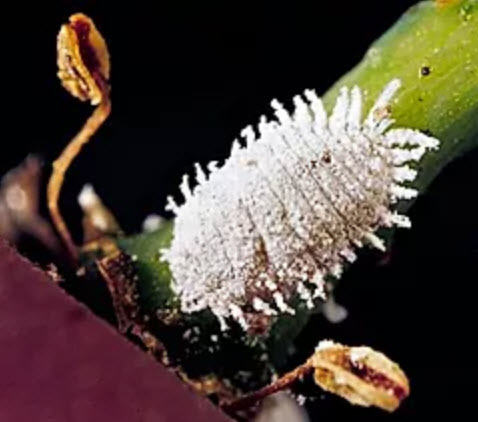
Three species of mealybugs in the genus Pseudococcus (grape, obscure, and longtailed mealbugs) and the vine mealybug (Planococcus ficus) are pests of winegrapes.
Origin: Vine mealybug (VMB) is native to Africa, South America, the Middle East and the Mediterranean regions of Europe. Studies indicate that the California strain of the species originally came from Israel
Current distribution: The primary species of concern in North Coast and San Joaquin Valley vineyards are the grape and obscure mealybugs. In Central Coast vineyards, obscure and longtailed mealybugs can cause damage. In the Coachella Valley, longtailed mealybug may occur. Vine mealybug occurs in all major California production areas.
Biology: Grapevines infected with grapevine red blotch disease show symptoms much like that of vine leafroll disease, where leaves turn red in the early fall, primarily at the base of shoots. Unlike leafroll, which exhibits green veins in the leaves, red blotch vines have red or pink veins in the leaves, red blotches on the leaves, and no rolling.
- The grape mealybug has two generations each year and overwinters as an egg or crawler in or near a white, cottony egg sac under loose bark and in the cordons or upper portions of the trunk. In spring most grape mealybug crawlers move toward the base of spurs, or under the loose bark of canes, and then onto expanding green shoots, reaching maturity in mid-May to early June. Most females return to old wood to lay eggs that hatch from mid-June to July. First generation crawlers then move out to the green portions of the vine to feed on fruit and foliage in late June or early July; mostly immatures are seen through July. Adult females will appear in late summer and early fall. Some females will oviposit in the fruit clusters but the majority of the females return to the old wood to lay the overwintering eggs.
- Obscure and longtailed mealybugs do not diapause over the winter and have multiple overlapping generations with all life stages present on the vines year-round. Obscure mealybug overwinters under the bark of the trunk, cordons, and spurs (the same as grape mealybug). In late spring some obscure mealybugs begin to feed on leaves, but most of the population remains hidden under the bark or in the tight clusters.
- The vine mealybug has four to seven generations per year, depending on temperature and location. All life stages might be present year-round on grapevines.
Host Range: In California, mealybugs feed predominantly on grapevines, although in other countries it can be a pest of fig, date palm, apple, avocado, citrus, a few ornamentals.
How it Spreads: Evidence suggests that this pest is spread by the movement of infested vineyard equipment (mechanical harvesters, bins, tractors, etc.) and nursery stock. Other possible modes include field crews and natural dispersion such as birds, wind-blown infested leaves, and crawling.
Potential Damage: Mealybugs damage grapes by contaminating clusters with cottony egg sacs, larvae, adults, honeydew, and black sooty mold. In Southern California, severe infestations have reduced vine growth and resulted in defoliation, bunch rots, and even spur and cane death. In addition, mealybugs can spread grapevine viruses such as leafroll and corky bark.