
Equity Principles
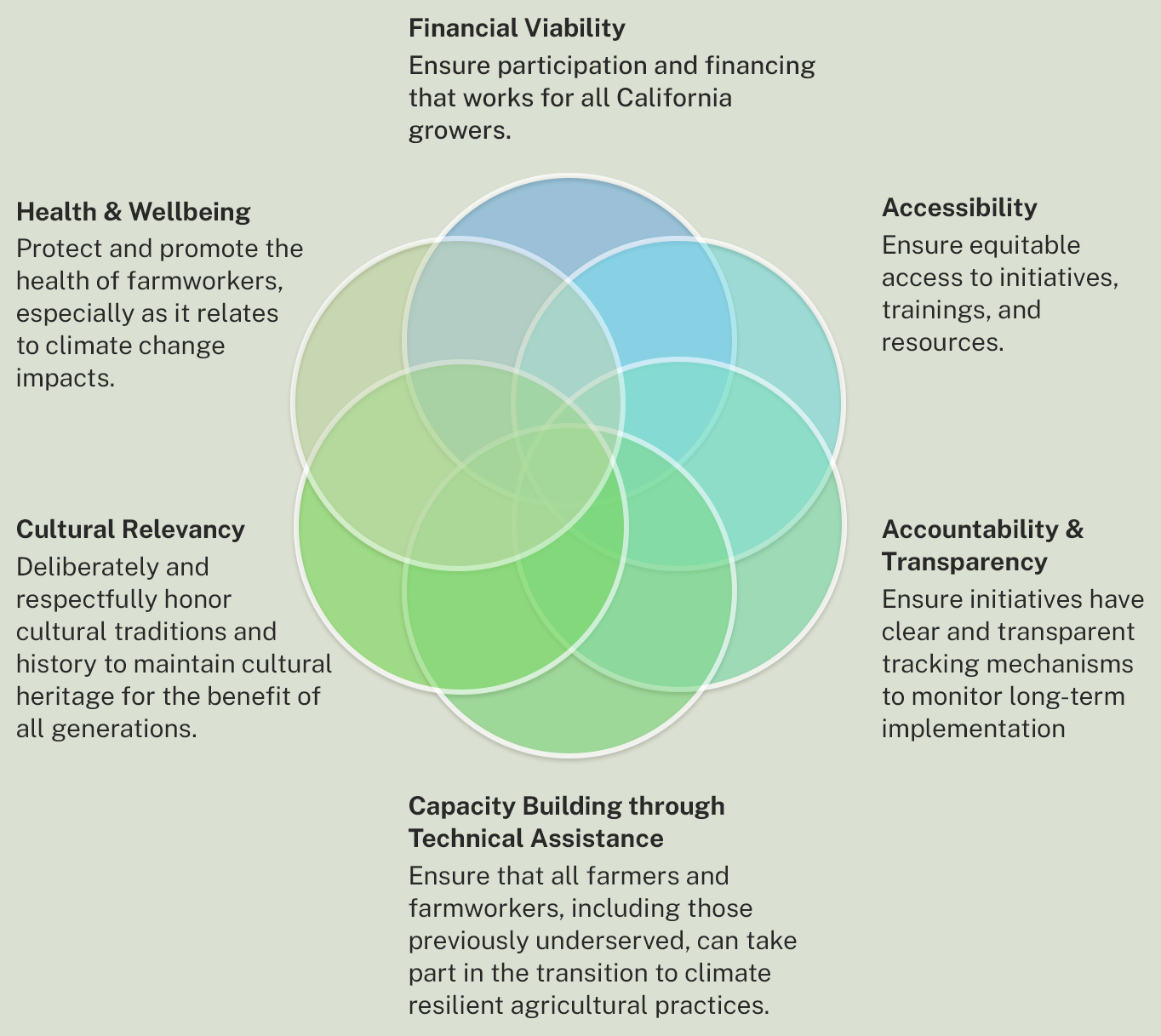
To help evaluate, improve, and develop equitable initiatives and policies that California state agencies implement, a set of Equity Principles was developed. These Equity Principles ensure that CDFA and partner agencies serve all farmers, ranchers and land stewards by providing a consistent set of guiding concepts to embed within plans, programs, policy development and implementation, to ensure access for all scales, crops and types of agricultural businesses in California.
The six Equity Principles describe the objective of each principle, a short description of what it considers, and a set of guiding questions for CDFA and other relevant agencies to use in initiative (i.e., policies, plans, and programs) evaluation and further customize according to their needs. These objectives are not designed as the only indicators or questions that should be addressed, but as a starting point for a robust and detailed exploration of equity.
Financial Viability
Objective: Ensure participation and financing that works for all California growers.
While most farmers and ranchers own their land, about nine percent of farms are on leased land. Many of these leases are short-term, which can make it difficult to participate in initiatives aimed at soil conservation and sustainable farming practices.
Guiding Questions:
- Are farmers who lease their land eligible for this initiative?
- Is there an opportunity to support or promote access to farmers who lease land through technical assistance or otherwise?
- Can farmers of all income levels participate in this initiative (e.g., are there stipends, reimbursements for costs, etc.)?
Capacity Building through Technical Assistance
Objective: Ensure that all farmers and farmworkers, including those previously underserved, can take part in the transition to climate resilient agricultural practices.
Technical Assistance increases the capacity of farmers and farmworkers transition to a climate-smart food system with high-road jobs; that is, jobs that improve the quality of life for workers by providing access to skills and economic opportunity and that use natural resources and human capital more efficiently. This includes upskilling and training farmers and farmworkers to participate in the shift to a low carbon economy, which utilizes alternative and regenerative agricultural methods.
Guiding Questions:
- Can all farmers access trainings and relevant resources to learn climate-smart agricultural practices?
- Can all farmers access technical assistance and/or other resources to enable underserved farmers to implement new practices and approaches?
Accessibility
Objective: Ensure equitable access to initiatives, training, and resources.
Initiative design must center the needs of all Californian farmers, including those previously underserved. This includes ensuring accessibility and flexibility around applications and participation in design processes. Initiatives should be available and advertised sufficiently to all farmers. For example, CDFA and other agencies are already doing work to translate materials into major languages. Documents should be written in clear language that minimizes jargon (see the California Office of Data and Innovation’s Plain Language Checklist). Initiatives that involve training must also consider the geographic location of farmers and should work to diversify training locations to reach a broader audience. Maximizing the accessibility of documents and educational opportunities will ultimately increase the reach, and therefore, success of initiatives.
Guiding Questions:
- Is the application process designed for all farmers, including those previously underserved? Do the timeline and budget requirements create burdens for beginner, veteran, or low-resourced farmers?
- Can everyone easily access information/education on the impacts of climate change?
- Are materials accessible for people who speak languages other than English?
- Can documents be easily understood?
- Is comprehensive technical assistance available throughout the process?
- Are trainings geographically accessible or accessible online?
- Are materials available and accessible to farmers without internet or with limited internet access?
- Have you conducted engagement with the target population to inform the design of the initiative?
Health & Wellbeing
Objective: Protect and promote the health of the agricultural workforce, especially as it relates to climate change impacts.
There are many climate change-related health risks for that agricultural workers, such as extreme heat, wildfire smoke, dust and particulate matter, and airborne illness and allergens. It is important to center the wellbeing of the agricultural workforce in the pursuit of farm programs and policies, while providing resources for agricultural communities impacted by climate change.
Guiding Questions:
- Does the initiative consider and seek to mitigate climate change related health impacts?
- Are the health impacts of to the agricultural workforce, especially from climate change and related impacts (e.g. extreme heat, dust and particulate matter, mold and fungus, etc.) considered and mitigated?
- Are protective equipment or technologies available if needed to mitigate impacts?
- Does the initiative provide information to help understand health risks and address impacts?
Cultural Relevancy
Objective: Deliberately and respectfully honor cultural traditions and history to maintain cultural heritage for the benefit of all generations.
All food production is derived from ancient practices, and many traditions may have their own specific practices. As such, agencies should ensure that their initiatives aimed at climate smart farming practices support culturally relevant farming practices including traditional ecological knowledge.
Guiding Questions:
- Does the design of the program allow for the inclusion of culture and traditions, including traditional ecological knowledge?
- Do the design and decision-making processes uplift shared values and accommodate cultural differences throughout implementation?
Accountability & Transparency
Objective: Ensure initiatives have clear and transparent mechanisms to monitor long-term implementation.
Agencies who are responsible for developing and updating their suite of initiatives must ensure that equity actions are properly implemented. Agencies should track and monitor the progress and benefits of their initiatives.
Guiding Questions:
- Does the initiative regularly collect and report data?
- What constitutes success in the short-term and long-term? How will the initiative meet the goals?
- Is there a process to provide feedback and to address any concerns raised in that process?
- Is there a process for upgrading and improving the initiative based on feedback?
- Are there adequate resources to achieve designed goals?
- What data or qualitative information will be used to assess success on goals?
- How will success be communicated to people supported by the initiative?