Trichomonosis
Bovine trichomonosis (aka trichomoniasis or trich) is a venereal disease of cattle caused by the protozoa Tritrichomonas foetus. The organism lives in the skin folds of the prepuce and internal sheath in bulls, and colonizes the vagina, cervix, uterus and oviducts of cows. It causes abortion and extended calving seasons. While cows generally clear the infection after two to three heat cycles, bulls will remain persistently infected and spread infection from cow to cow during natural service. Bulls over four years old are typically the main reservoir of infection in a herd. This is because older bulls often have deeper preputial folds (crypts), which serve as a more hospitable environment for trich to live.
Certain herd management practices are risk factors for infection: commingled grazing or fence-line contact with other herds is one documented risk factor. Control of T. foetus in an infected herd includes testing bulls and culling those infected. Although use of younger bulls has been recommended as a control strategy because they have a lower prevalence of infection than older bulls, such use will not eliminate the possibility of infection. Artificial insemination is considered the classic method for controlling venereal diseases of cattle. However, this is often impractical in range cattle operations due to lack of facilities, expertise or management practices. Additionally, annual pregnancy testing and culling of non-pregnant cows can help control herd infection. Vaccination of females can decrease duration and severity of infection. If exposure to other risk factors cannot be avoided, vaccination is believed to help reduce economic loss.
Trichomonosis can be economically devastating to herds affected. Costs are often insidious and difficult to quantify. Economic losses due to T. foetus infection can exceed 22% of expected annual income, which can exponentially increase with increasing prevalence (number of bulls infected in a herd). Losses to cow-calf herds include cost of replacement bulls, loss of genetic potential due to culling, increased days-to-conception, and subsequently lighter weaning weights.
California Trichomonosis Control Program
Trichomonosis is a serious economic threat to California’s cattle herds. The California Cattlemen’s Association and the Western United Dairies sponsored legislation to develop a trichomonosis control program. In partnership with the livestock industry, the California Department of Food and Agriculture (CDFA) developed regulations to support the program that became effective September 21, 2003. At the request of the cattle industry, the control program was strengthened with new laws that became effective October 2007 and the real-time PCR test was added as a diagnostic method in March 2011. Continuing efforts to improve the program led to additional changes that went into effect April 1, 2017, including requiring PCR for certain testing, addressing non-virgin bulls less than 18 months of age, and utilizing trichomonosis approved eartags.
A summary of the latest program changes can be found here: Summary of Regulation Changes - Trichomonosis Program
Trichomonosis is a reportable disease. Veterinarians, laboratories, or owners must report cases of trichomonosis to CDFA within two days of diagnosis. Negative trichomonosis tests must be reported to CDFA within 30 days.
CDFA personnel investigate trichomonosis cases, notify owners of potentially exposed cattle, and quarantine bulls in infected and exposed herds. Infected bulls will be quarantined to their facility and may ONLY BE SOLD FOR SLAUGHTER. Additionally, one negative real-time PCR test at owner’s expense is required for all herdmate bulls. Owners of exposed cattle will be notified by CDFA and are required to test their bulls once, at their expense. Herds affected more than once in a two year period will require two real-time PCR tests.
Trichomonosis Tags
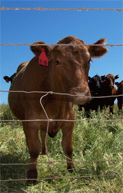
As of April 1, 2017, bulls, when trichomonosis tested, will require both official individual ID AND a “Trichomonosis approved color-coded tag”. This tamper evident California trichomonosis tag is available to California trichomonosis approved veterinarians from the MWI Veterinary Supply Company (1-800-824-3703). The California trichomonosis tag program will follow the same year (September 1 to August 31) and color schedule (white for 2016-17, then cycling through orange, blue, yellow, green) as used by neighboring states. The tags are required to be removed and replaced with current year tags during the trichomonosis testing process. The individual official ID of each bull tested for trichomonosis must be recorded and accompany the trichomonosis sample to the laboratory. Trichomonosis approved tags are NOT official ID.
Reminder: The 2026-2027 trichomonosis year begins September 1, 2026. Bulls tested through August 31, 2026, should receive a green CA trichomonosis approved tag; bulls tested starting September 1, 2026, should receive a white CA trichomonosis approved tag.
Additional information on use:
- The trichomonosis approved tag can be put in either ear.
- If a bull tests positive, the trichomonosis tag should be removed.
- If a bull is tested more than once during a Sept. 1-Aug. 31 tag year, a new tag may be put in, or the existing tag may be used with the number recorded on the test report form.
.jpg)
For Veterinarians and Labs
Sample quality and testing are critical for diagnosing and eradicating trichomonosis. Law requires training and approval by CDFA for veterinarians collecting trichomonosis samples, and for laboratories processing samples.
California licensed, category II USDA accredited veterinarians can view a training video to become approved for Trichomonosis sample collection in California. Training and approval by CDFA must be renewed every two years. The training video can be viewed using the link below, and Certificates of Completion following training should be returned to your Animal Health District Office.
Certificate of Completion of Trichomonosis Sample Collection Training
Laboratories must go through a training session at the California Animal Health and Food Safety Laboratory (CAHFS) to be approved to read trichomonosis samples. Laboratories are commonly private veterinary clinics, but can be other private labs. CDFA requires that at least one person in the lab/clinic be trained through a short session at CAHFS; training should be repeated if that person leaves the lab/clinic. Veterinarians/clinics may contact their Animal Health Branch District Office to complete the scheduling form. CDFA will then contact the individual to confirm training date and location.
For Public Sale Yards
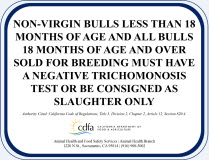
Bulls 18 months of age and older, and non-virgin bulls under 18 months of age, must be accompanied by a negative trichomonosis test completed within 60 days prior to sale, or be sold for feed and slaughter only. Packers can purchase these bulls for immediate slaughter, or these bulls can be sold to dealers who are licensed with California and/or registered with Packers and Stockyards as federally approved dealers; all dealers must have an agreement with CDFA before purchasing untested bulls for slaughter. Changes to the trichomonosis program, effective April 1, 2017, contain several other exemptions for the sale of bulls in California without a negative trichomonosis test – more information can be found in the summary of Changes to California’s Trichomonosis Program.
Contact CDFA
CDFA can be contacted via e-mail at trich@cdfa.ca.gov to order additional testing forms or to ask questions about California’s Trichomonosis Program.
Your local Animal Health Branch District Office is available to provide guidance to producers and veterinarians in all areas of California's Trichomonosis Program. District offices will be the primary point of contact for investigating positive trichomonosis test results.
Resources
Testing and Forms
Contact Us
CDFA Animal Health and Food Safety Services,
Animal Health Branch
Sacramento, California 95814
Phone: 916-900-5002
Fax: 916-900-5333
Email: ahbfeedback@cdfa.ca.gov