
Sheep and Goat Health Information & Resources
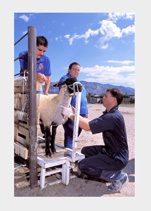
The small ruminant industry is invaluable to California's agriculture. The Animal Health Branch aids in the management of sheep and goat diseases that cannot be managed by a single producer and their veterinarian. If you raise small ruminants, having a private practitioner to aid in disease diagnosis is important because of the highly contagious nature of some diseases to small ruminants, other species of livestock and/or people. The risks of disease introduction are greater than ever, because of expanding international trade and travel. A highly transmissible foreign animal disease can spread rapidly if undetected or detected but not reported. Some signs to look for are oral blisters and lameness, unusual or unexplained illness, hemorrhagic septicemias, high morbidity or mortality. If you suspect you are dealing with such a disease, contact your district office.
The demand for sheep and goats in California is increasing greatly. Expanding ethnic populations have created new demands in the market place. Some marketing may occur through non-traditional avenues, which are not easily monitored. The Animal Health Branch recognizes this potential risk and approaches issues accordingly when dealing with diseases within the various segments of the sheep and goat industry. CDFA continues to develop programs and policies that are adjustable to the continuing changes in the industry, while at the same time protecting the well-being of sheep, goats and other livestock in California.
Since animal diseases may affect sheep and goat populations in any state, there are Federal-State Cooperative Programs (FSC) that address these diseases. Scrapie in sheep and goats is an example of a FSC program.
Anthrax
Anthrax is a potentially fatal disease of all warm-blooded animals, including humans. The disease is caused by a spore-forming bacterium called Bacillus anthracis. Species susceptibility varies. Cattle, sheep and goats are considered highly susceptible and birds highly resistant. In animals, transmission occurs by ingestion and possibly inhalation of spores. For more information, see our Anthrax Fact Sheet.
Brucella melitensis
Brucella melitensis (B. melitensis) is an infectious bacterial disease that can affect most domestic animals, but goats and sheep are especially susceptible. The bacteria causes a severe debilitating disease in people. Do not confuse this disease with other brucella infections: B. ovis causes infertility in sheep but does not spread to people or other animals; B. abortus (a cattle disease agent) can, although very rarely, infect sheep and goats. For more information, see our Brucella melitensis Factsheet.
Club Lamb Fungus (Ringworm)
Club Lamb Fungus (Ringworm) Factsheet
Foot and Mouth Disease
Foot and Mouth Disease (FMD) is a debilitating disease affecting all cloven–hoofed animals, including cattle, pigs, and sheep. Clinical signs commonly seen in cattle are drooling, lip smacking, and lameness, caused by blisters (vesicles) on the tongue, dental pad and feet. Sheep and pigs have similar, but often less pronounced, clinical signs. For more information see our Foot and Mouth Disease web page.
Rabies
Rabies is a viral disease affecting all mammals that is invariably fatal if not treated. Cases are diagnosed in livestock, as well as in dogs, cats, and wildlife. CDFA, along with the California Department of Health Services, monitors cases in livestock. For more information see the Department of Health Services Center for Disease Control web page.
Scrapie
Scrapie is a fatal, degenerative disease affecting the central nervous system of sheep and goats. It is among a number of diseases classified as transmissible spongiform encephalopathies (TSE). Infected flocks that contain a high percentage of susceptible animals can experience significant production losses. Over a period of several years the number of infected animals increases, and the age at onset of clinical signs decreases making these flocks economically unviable. Animals sold from infected flocks spread scrapie to other flocks. The presence of scrapie in the United States also prevents the export of breeding stock, semen, and embryos to many other countries. For more information see our Scrapie web page.
Screwworm
Screwworms are fly larvae (maggots) that feed on living flesh. These parasites can infect any warm-blooded animal. Screwworms enter wounds as small as an insect bite and feed on living tissue in the area. If untreated, screwworm infestations can be fatal. In the US, Screwworm is a Foreign Animal Disease reportable within 24 hours of diagnosis. Screwworms have most recently entered the U.S. in dogs that have been imported from areas of the world where the flies are endemic. For more information see our New World Screwworm web page.
Sheep and Goat Entry Requirements & Inspections
Sheep Entry Requirements – Englishfor Sheep Entry Requirements Spanishfor Sheep Entry Requirements
Goat Entry Requirements – Englishfor Goat Entry Requirements Spanishfor Goat Entry Requirements
Resources
Follow Us
Contact Us
CDFA Animal Health and Food Safety Services,
Animal Health Branch
Sacramento, California 95814
Phone: 916-900-5002
Fax: 916-900-5333
Email: ahbfeedback@cdfa.ca.gov