The Livestock Industry Greatly Appreciates Your Support!
Handbook & Field Reference
Contents
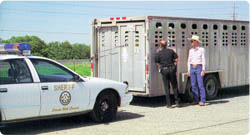
Animal Stops: Road Enforcement to Deter Livestock Theft
- Road Enforcement activities have been mandated through the California legislature by the Livestock Industry to deter theft.
- How do livestock stops and Livestock Transportation Report writing aid in theft enforcement and prevention?
- The thief is most vulnerable when transporting stolen cattle on a public thoroughfare.
- Sections 20438 /23043 (a) of the California Food and Agricultural Code give all peace officers the authority to stop any vehicle hauling cattle or horses for the purpose of making an investigation.
- Detection and enforcement of the California Food and Agricultural Code sections enacted to protect the livestock industry can be evidenced from the paperwork required to accompany the load.
- Violations consist of misdemeanors and felonies.
- Local Brand Supervisors and Brand Inspectors are available to assist in your investigations and provide care for animals in the event of a seizure.
- This handbook has been compiled for your use as a field reference guide.
Required Documents for Transporting Livestock & Poultry
Species Specific Code Sections:
- Cattle 20438, (F & A)
- Horses, Mules, Burros, Sheep 23043, (a) (F & A)
- Poultry 26603, (F & A)
- Swine 26603, (F & A)
Documents Required For Transportation:
- Cattle
- Brand Inspection Certificate, Bill of Sale or Consignment, Saleyard Outbilling, Permit, Fair Certificate, Health Certificate See details on reverse side.
- Horses, Mules, Burros
- No documents required at this time unless destined for slaughter
- Sheep
- Bill of Lading containing the name of the owner of the sheep and destination of the sheep
- Poultry
- Must carry a record containing all of the following:
- Point of origin & destination
- Names and addresses of the shipper and consignee
- The kind and quantity of poultry being transported
- Must carry a record containing all of the following:
- Swine
- No documents required at this time
Sections To Cite For Non-Compliance:
- Cattle
- Horses, Mules, Burros – Not citable unless being transported to slaughter
- Sheep – 23981,(F & A)
- Poultry – 26603, (F & A)
- Swine – Not citabl
Authority To Seize If Documents Seem Suspicious, Or If Not In Possession (If Required) Or Officer Is Suspicious Of Circumstances Of Transport Or Ownership:
- Cattle - Live / Hides / Parts / or Carcass hide on – 20438, (F & A)
- Horses, Mules, Burros as above – 23043, (b)(F & A)
- Sheep as above – 23043 , (b)(F & A)
- Poultry live animals – 26603, (F & A)
- Swine – No specific section
Other Violations:
- Refusal to show documents of cattle transportation
- Cite – 20203 (F & A)
- Arrest – 148 (PC)
- Inhumane transportation conditions – 597 (a), (PC)
- Failure to care or provide for animals – 597 (f), (PC)
Required Documents for Transporting Cattle
- All transportation of cattle must have paperwork or documents to accompany the load.
- They may include one or more of the following:
- Bill of Sale or Consignment – Also known as a yellow slip (completed by owner/agent)
- Brand Inspection Certificate (Numbered Form) – or Supplemental Brand Inspection Certificate Completed by Brand Inspector at point of origin inspection
- Saleyard Outbilling (Numbered form) – Bill of sale or certificate of sale with saleyard letterhead "receipt" (completed by saleyard)
- Transportation Permit (Numbered form)
- Cattle leaving a registered feedlot transported out of state directly for immediate slaughter (completed by feedlot)
- Cattle transported across the California state line for a not more than 50 miles from origin to destination (completed by owner/agent)
- Cattle transported across a modified point-of-origin boundary for a distance not to exceed 40 miles from loading point to destination (completed by owner/agent)
- Fair or Livestock Exhibit Certificate – Completed by Fair Manager or Official
- Health Certificate (Numbered form) – Cattle entering California from a state without a brand inspection program (completed by licensed veterinarian)
- A Bill of Sale or Consignment is a State issued form and is usually completed by the owner or agent for the shipment. It is required for consignment of cattle to a saleyard, feedlot, or slaughterhouse (all of which are destination inspection sites).
- Also, it is required when no inspection is necessary, but cattle are being transported for pasture purposes within the State of California only. Pursuant to Section 21703 (F & A), the form Shall be used and Shall contain ALL of the following information:
- The date of sale or consignment.
- The loading point.
- The name and address of the owner or consignor, or both.
- The destination.
- The number and description of the animals including their brands, if any.
- The name and address of the buyer or consignee, or both.
- The name of the transporter or carrier and the license number of the vehicle used to transport the animals
- The signature of the owner or his authorized agent.
- If the hauler has a Bill of Sale or Consignment or other listed documents, he is not in violation of 21705 (F & A).
- If the documents, Certificate or Bill of Sale are not completely filled out or are inaccurate, there is a violation. The transporter isresponsible for having documents, but only the shipper is responsible for the accuracy of the information required in the document.Inaccurate or incomplete documents are a violation of 21703 (F & A).
Brand News
Contact Us
California Department of Food and Agriculture
Animal Health and Food Safety Services, Bureau of Livestock Identification
1220 N Street
Sacramento, California 95814
Telephone: 916-900-5006
Fax: 916-900-5335
Or send an email to the bureau: bliinfo@cdfa.ca.gov